If you run a limited company, Corporation Tax is the big one. Every company pays it on its profits, files a CT600 return, and works to a set of deadlines that differ from Self Assessment. Here is how it all fits together, without the jargon.
The short version
Your company pays Corporation Tax on its profits at 19% up to £50,000 and 25% above £250,000, with marginal relief in between. You must pay within 9 months and 1 day of your year end, and file the CT600 within 12 months. You file even if you made a loss.
What Corporation Tax is charged on
Corporation Tax is a tax on your company's profits: its trading profit, plus investment income and any gains from selling assets. There is no personal allowance for companies, so tax is due from the first pound of profit.
The rates, and marginal relief
| Profit | Rate |
|---|---|
| Up to £50,000 | 19% (small profits rate) |
| £50,000 to £250,000 | 25% with marginal relief, an effective rate that tapers up |
| Over £250,000 | 25% (main rate) |
The £50,000 and £250,000 thresholds are shared between associated companies and reduced for accounting periods shorter than 12 months. Marginal relief means a company in the middle band pays somewhere between 19% and 25% overall, rising smoothly as profits grow.
What the CT600 actually is
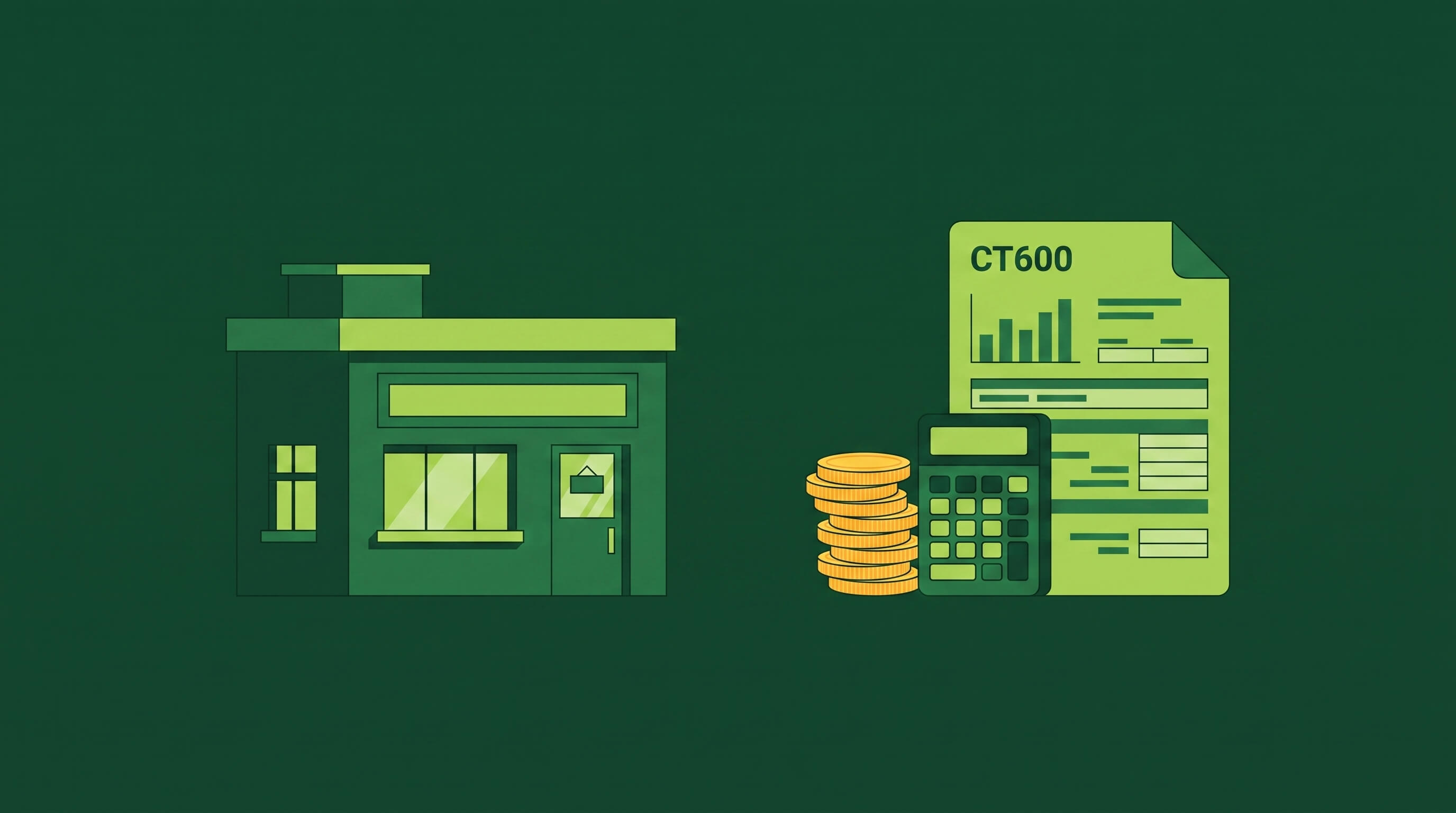
The CT600 is the Company Tax Return. It reports your profit, works out the tax, and is filed online with HMRC. It does not travel alone. You file three things together: the CT600 itself, your statutory accounts, and a Corporation Tax computation that shows how you got from accounting profit to taxable profit. Accounts and computations must be sent in a machine-readable format called iXBRL.
You file even with a loss
A common myth is that a loss means no return. Not so. If HMRC has asked for a return, you must file a CT600 even if your company made a loss or owed nothing. Losses can often be carried forward to reduce future tax, but only if they are reported.
The deadlines, and the twist
Corporation Tax has a quirk that catches new directors out: you pay before you file.
- Pay your Corporation Tax within 9 months and 1 day of the end of your accounting period.
- File your CT600 within 12 months of the end of your accounting period.
- Send your annual accounts to Companies House within 9 months of your year end, or within 21 months of incorporation for your very first accounts.
- File a confirmation statement with Companies House at least once a year.
Very large companies pay in quarterly instalments instead, but most small companies pay in a single lump.
A worked example
Say your company's accounting period ends 31 March 2026 and it made £40,000 profit. Corporation Tax at 19% is £7,600. You would need to pay that by 1 January 2027 (9 months and 1 day after year end) and file the CT600 by 31 March 2027. Your accounts would be due at Companies House by 31 December 2026.
Registering and staying on top of it
You must tell HMRC your company is active and register for Corporation Tax within 3 months of starting to trade. From there it is about keeping clean records all year so the return is a summary, not an investigation. Small companies can usually file simplified micro-entity accounts, which keeps the paperwork light. Note that Making Tax Digital for Income Tax does not apply to companies, so there is no quarterly filing for Corporation Tax at this stage.
CT600 without the headache
Oazy prepares your Corporation Tax return from your company's bank data. Its AI categorises transactions, drafts the computation and the CT600, and flags anything it is unsure about, so you get a clear, explained draft to review and file. See it in your account.